Identifying Your Durango Door Glass and Tint Configuration
Determining which replacement glass you need depends entirely on whether you are replacing a front roll-down pane or one on the rear passenger doors. Up front, Chrysler used a single-pane tempered glass with a standard light-green solar tint across every single model, whether your truck is a base SLT, a high-trim R/T, or a Sport edition. Rear doors, however, came from the factory in two completely different configurations: standard light green solar glass or deep privacy tint. Holding a plain white sheet of paper behind your intact rear door or rear quarter glass makes it easy to spot: if the paper appears nearly white with a faint greenish hue, it is standard solar; if the paper is obscured and dark charcoal, you have factory privacy glass.
The glass layout also differs between positions. The front doors use a single piece of glass that interchanges directly with the 2000–2004 Dodge Dakota Quad Cab front doors. The rear doors feature a two-piece design: the roll-down pane moves alongside a stationary rear quarter vent window, divided by an upright vertical steel division bar. I do not touch the fixed rear vent glass unless it is broken, as the roll-down glass slides in its own felt channel beside it.
| Door Position | NAGS Part Number | Tint Style | Interchange Notes |
|---|---|---|---|
| Front Driver Side (LH) | DD09277 | Green Solar Tint | Interchanges with 2000–2004 Dakota Quad Cab |
| Front Passenger Side (RH) | DD09276 | Green Solar Tint | Interchanges with 2000–2004 Dakota Quad Cab |
| Rear Driver Side (LH) | DD09279 | Green Solar or Dark Privacy | Runs against fixed vent division bar |
| Rear Passenger Side (RH) | DD09278 | Green Solar or Dark Privacy | Runs against fixed vent division bar |
Mechanical Hardware and Failure Signs Inside the Door Shell
Inside the full-frame stamped steel doors, your glass bolts directly into a single-rail, cable-and-drum electric window regulator assembly using metal mounting brackets clamped to the lower edge of the pane. When a window on this vehicle suddenly refuses to roll up, tilts sideways, or falls straight into the bottom of the door, the glass itself is rarely the source of the mechanical issue. The original factory regulators rely on plastic cable pulleys and carrier clips that dry out and crack with age. When the plastic breaks, the steel drive cable jumps off the pulley tracks, tangles in the drum, or snaps entirely under motor tension.
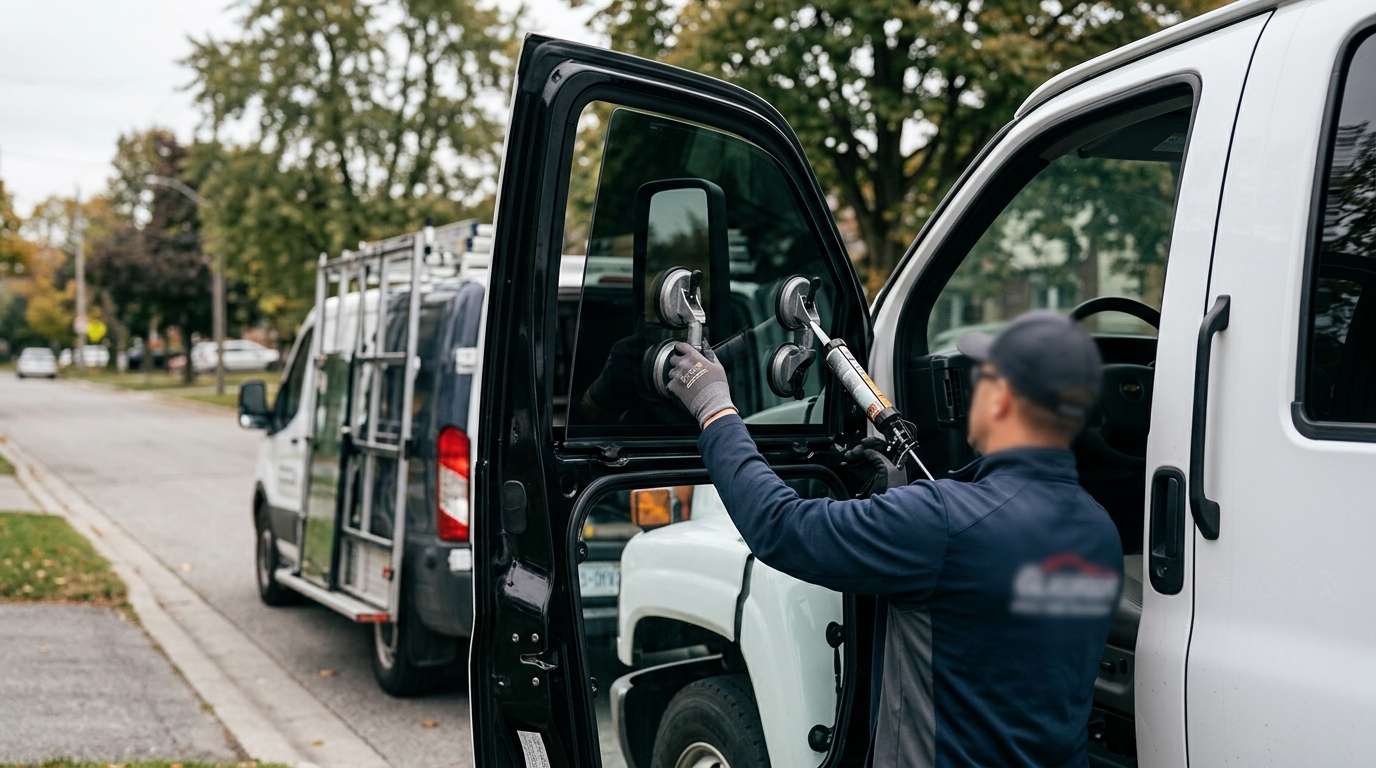
Grinding, crunching, or repetitive clicking sounds inside the steel door cavity right before the glass stops moving indicate that the cable has frayed or jumped its plastic guide. Furthermore, hardened or dried-out rubber and felt run-channels—especially the strip seated inside the rear division bar—force the electric motor to pull against heavy friction, accelerating pulley failure. Because dealing with a collapsed window leaves your vehicle completely open to theft and weather, I provide all door glass replacements purely on a mobile basis across Toronto and the GTA, meeting you directly at your house or your job site to do the work.
Interior Stripping and Glass Retention Details
Accessing the lower glass clamps requires pulling the interior door trim panel, undoing the hidden armrest fasteners, and peeling back the factory water barrier shield. Because the glass features no embedded sensors, antennas, or heating elements, the primary focus is aligning the bottom brackets evenly on the regulator carrier so the pane sits squarely between the division bar run and the front frame channel. Inner and outer horizontal dew wipes clip along the top edge of the door slot to shed water away from the motor, but any moisture that bypasses them drains through the bottom pinchweld weep holes once the glass is secured in place.