Sourcing the Correct Sunroof Glass for Eclipse Coupe Trims
Sourcing glass for this roof requires filtering out the Spyder convertible completely, as the soft-top trim shares zero roof hardware with the coupe. Factory power glass panels were standard or optional on the GS, GT, and later GTS liftbacks, but absent from base RS builds unless an aftermarket pop-up unit was cut in by a third party. Those aftermarket cut-outs do not match the factory electric tilt-and-slide framework, meaning a genuine replacement panel will only fit cars built with the factory power sliding cassette. The factory assembly carries dealer part number MR384486, spanning the full 2000 through 2005 3G run without dimensional revisions across the mid-cycle refresh.
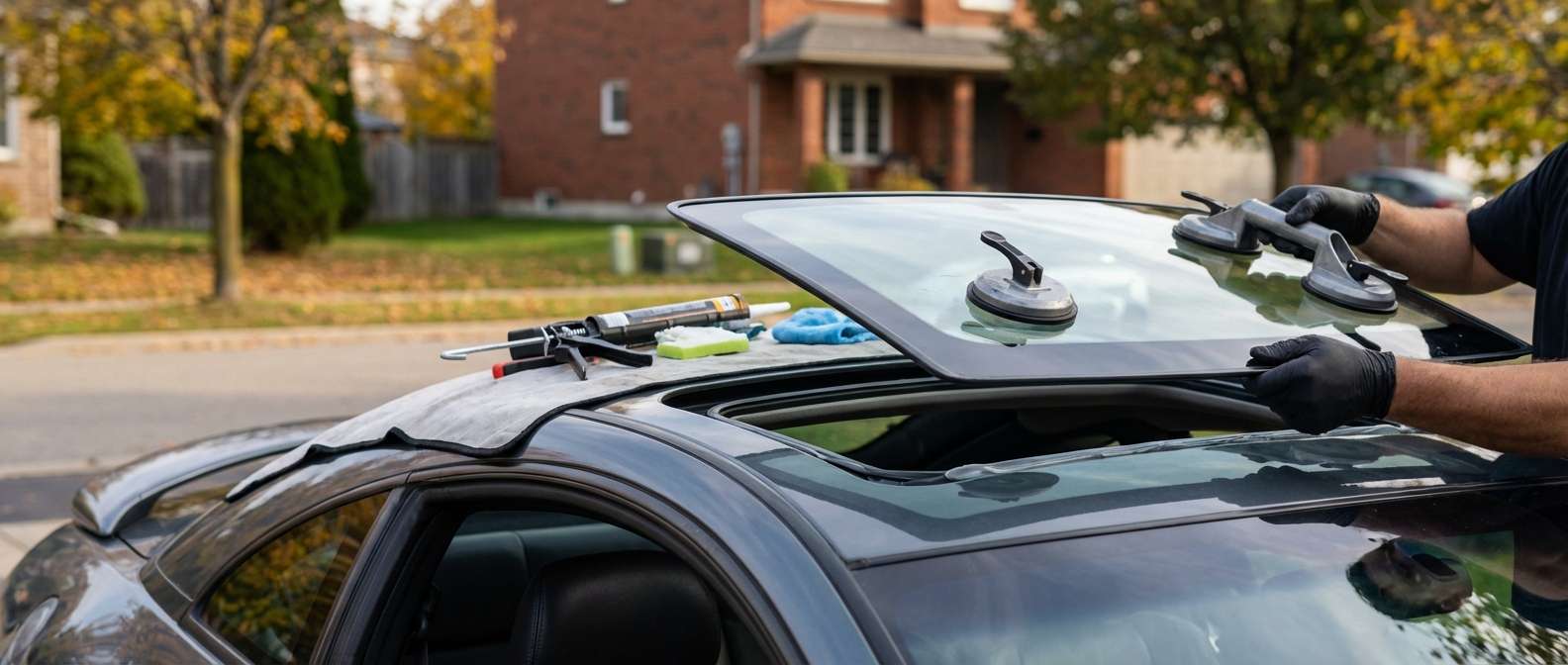
The panel itself measures roughly 31 3/4 inches long by 21 1/4 inches wide, finished with a dark solar tint. Unlike fixed windshield or back glass applications, this sunroof is a completely passive assembly with no defroster lines, radio antenna elements, rain sensors, or integrated electronics. It relies entirely on a pre-bonded metal perimeter sub-frame bonded underneath the glass edges and an attached outer edge seal to close the aperture against the vehicle roof skin.
Mounting Architecture and Water Management Channels
The mechanical bond between the glass panel and the motor-driven lift mechanism uses a straightforward bracket layout rather than urethane adhesive. The glass assembly secures to the sliding track assembly using two mounting fasteners on each side, concealed behind the interior edge finish. Beneath the glass, a four-corner drainage system catches water that slips past the perimeter moulding, channeling run-off through front A-pillar and rear C-pillar hoses directly down to the lower rocker sill drains. A manually operated, cloth-wrapped sunshade rides inside the internal roof cassette tracks independently of the glass.
When working on these third-generation liftbacks, I install high-grade aftermarket replacement glass from manufacturers like Pilkington, PGW, FYG, and XYG that match the original carrier frame contours. Aligning the panel during replacement requires checking that the perimeter rubber moulding sits flush with the exterior steel roofline. If the underlying metal carrier is warped from rough handling or an old collision, the seal will fail to compress evenly against the roof opening, overwhelming the internal drain gutters and letting highway wind roar through the cabin.
Addressing Mechanism Wear and Water Intrusion Issues
Water collecting in the front footwells or staining the headliner around the overhead console switch is usually the result of disconnected or silt-clogged A-pillar drain hoses rather than a fractured glass panel. The factory plastic drainage spouts and rubber hoses shrink over time, slipping off the sunroof cassette corners during heavy rain. Before swapping broken glass, I clear these drain lines and verify that the track guides are intact. The drive cables and nylon track shoes in these cassettes frequently crack or bind with age, causing the glass panel to skew sideways or jam half-open when operating the tilt switch.
The exterior perimeter rubber seal bonded to the frame carrier is also prone to severe dry rot after decades of sun exposure. Once that rubber hardens, it allows excessive water volume into the collector tray, which quickly overwhelms the internal troughs if the car is parked on an incline. Replacing a shattered or mechanically damaged glass panel requires transferring the assembly carefully to avoid bending the lower mounting brackets, ensuring the replacement panel seats squarely into the roof aperture.