Freestyle Doors and Torsional Stress on RX-8 Glass
The absence of a traditional fixed center pillar in this car drastically changes how the windshield interacts with the body. Because the rear-hinged half doors latch directly into the roof and sill rather than a central steel post, road vibrations and cornering forces channel heavily into the A-pillars. On enthusiast forums, owners frequently point out cabin creaks originating right at the perimeter of the glass when entering angled driveways or taking hard corners. The windshield serves as an indispensable structural brace that maintains diagonal rigidity across the entire cowl area. If a replacement piece flexes even slightly more than the factory laminate, or if the bonding plane twists under chassis load, you get persistent air leaks along the upper edge and interior trim rattles that are nearly impossible to quiet down afterward.
Series 1 and Series 2 NAGS Identification Issues
Sorting through glass codes requires matching both the production phase and your interior mirror setup. Pre-facelift cars from 2004 to 2008 use either FW02396 or FW02433, with the distinction coming down to whether the car arrived with a standard wedge mirror or the bulkier auto-dimming unit with HomeLink, alongside choices between clear green solar tint (GTN) or an added blue top shade band (GBN). A routine frustration discussed by drivers online is ordering glass only to discover an aftermarket panel fitted with a bare manual mirror wedge, leaving nowhere to anchor the heavier electrochromic harness. For the refreshed 2009 to 2011 models, the catalog splits into FW02983 for base manual wipers and FW02984, which includes the factory optical bracket for automatic wipers and dusk sensors.
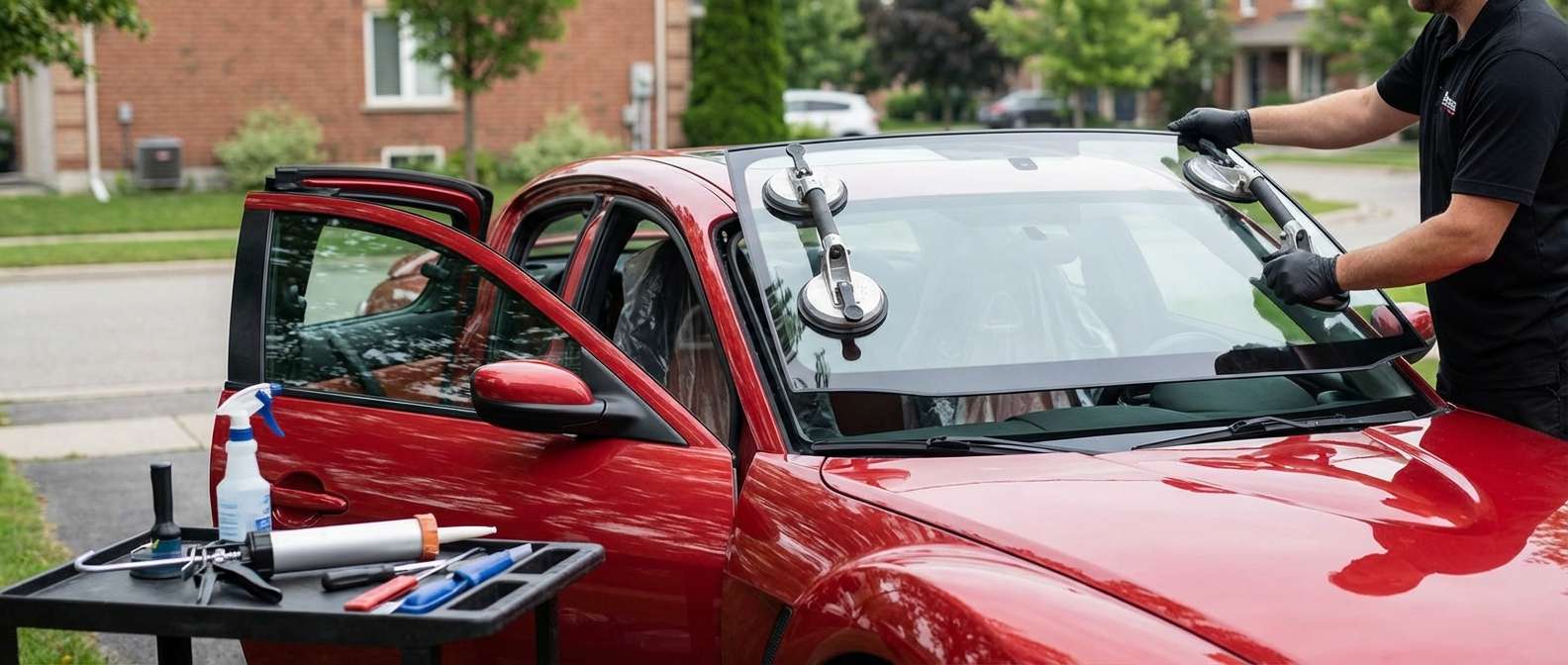
Whenever I travel to your home or workplace across Toronto and the GTA to replace an RX-8 windshield, getting the exact rear-view mount matched ahead of time prevents the frustration of loose mirror wiring hanging over your dash. For cars running the FW02984 pane, the round rain-sensing prism requires a brand-new optical gel pack during the swap; reusing a dry or pitted pad invariably leads to erratic wiper activation or non-responsive headlights.
Rotary Heat Damage and Surround Mouldings
Working around the base of the glass exposes a challenge unique to the RENESIS powerplant: extreme underhood heat soak. The engine bay temperatures cook the plastic cowl grille tabs and push-pins to extreme brittleness over the years, making the two-piece panel underneath the wiper pivot arms fragile to lift away. Removing the windshield cleanly requires replacing the continuous three-sided outer rubber trim, which corresponds to aftermarket part WFS F2396 on the earlier cars and WFS F2984 on the facelifted versions. Reusing an old reveal moulding is out of the question because the lip shrinks and bakes stiff, resulting in wind buffeting along the roofline.
Inside the cabin, the molded A-pillar garnish panels snap into metal tension clips directly over the side curtain airbag tethers. These pillars sit flush against the glass borders, meaning the replacement glass profile must follow the original perimeter curve perfectly so the interior fabric pillars do not push outward or leave unsightly gaps against the daylight opening.