The Frameless Glass Layout on the M157 Body
If you are looking for a separate vent window or rear quarter pane to replace on your car, you will not find one. Maserati designed the M157 Ghibli with four frameless side windows, deliberately cutting out the stationary division bars and triangle glass you normally see on executive sedans. While its larger sibling, the Quattroporte, relies on a fixed quarter pane inside the rear door frame, the Ghibli keeps a continuous coupe silhouette with solid sheet metal on the C-pillar right where the famous Trident badge sits. NAGS catalogs do not carry a front vent (FV) or rear vent (RV) listing for this vehicle simply because no separate vent glass assembly exists anywhere on the doors.
Instead, each door uses a single large pane of drop glass that handles the entire window opening. The rear doors carry full panes under factory numbers 670004370 for the right rear and 670004373 for the left rear. Up front, the movable glass runs under NAGS prefixes FD28713 and FD28714. Depending on whether your car is a base rear-wheel-drive model, an S Q4, or a Trofeo, the car came with either standard solar-tinted tempered panels or optional dual-pane acoustic laminated glass designed to suppress cabin turbulence. When damage strikes the rear section of the cabin, it is always this main drop pane that has broken or detached, not a smaller secondary vent.
Index Drop Failures and Regulator Cable Binding
Because these doors lack an upper structural window frame, the glass has to slip beneath the roofline weatherstrip whenever the latch operates. When you pull the exterior handle, an electronic microswitch commands the regulator to drop the pane roughly a quarter-inch out of the upper rubber channel. If an AGM battery drains low or a microswitch fails, the glass stays fully elevated. Shutting the door in that state forces the top edge of the pane directly into the exterior aluminum roof trim, chipping the glass corner or shattering the entire piece across the back seat.
I also see glass cracked internally by the door regulator hardware. The cable-and-pulley mechanism inside the M157 door card is prone to binding; when the plastic pulley channels wear down, the cable snaps off track and twists the lower glass clamping brackets. The resulting uneven torque binds the pane sideways against the vertical run channels, snapping the bottom edge under tension. Whenever I replace this drop glass, my workmanship is backed for as long as you own the vehicle, while the replacement glass itself carries one year of coverage against defects. Getting the vertical tilt and clamping depth dialed into the carrier clamps prevents the glass from dragging against the internal door frame guides.
Post-Replacement Inspection Points for Owners
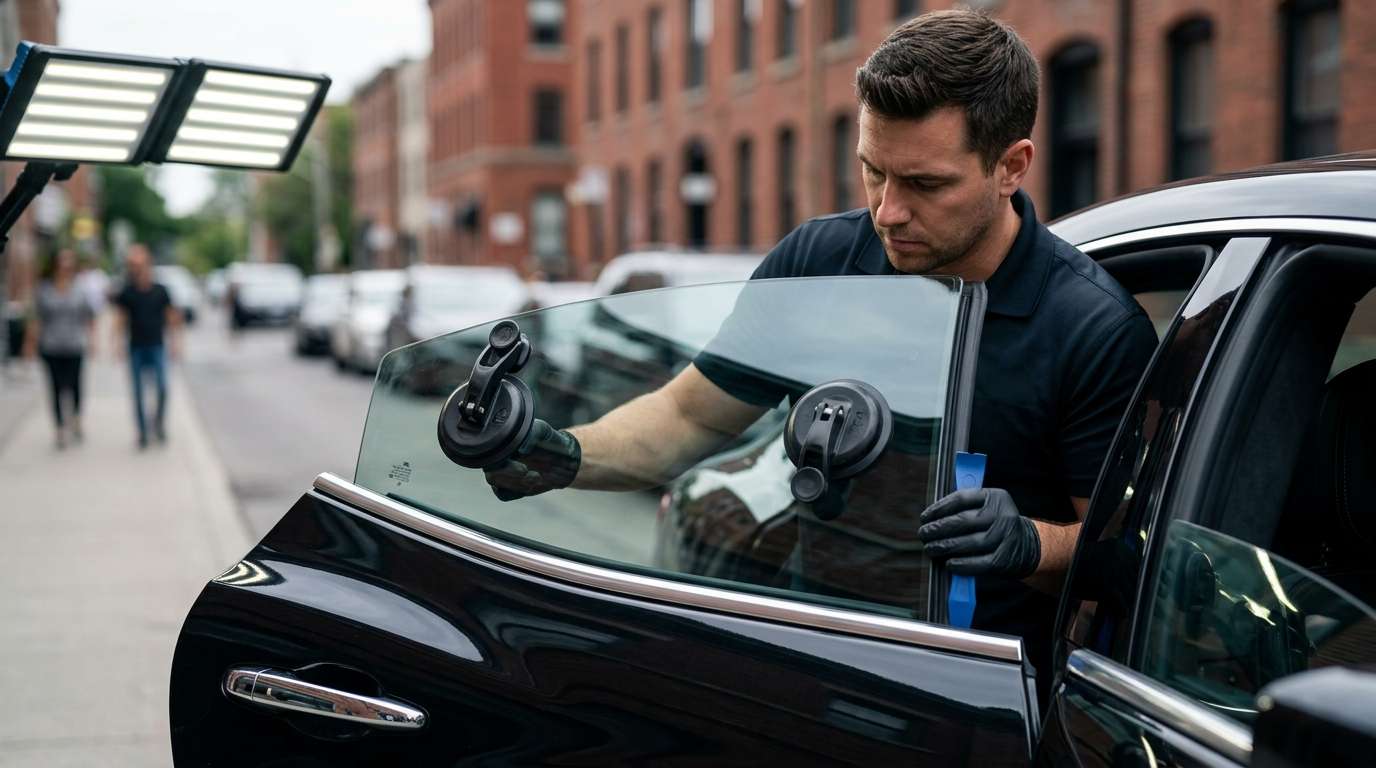
Once your new door glass is seated and adjusted to the factory weatherstrips, check these specific operational points before driving:
- Index Drop Timing: Pull the door handle slowly and verify the glass drops immediately by a few millimeters before the latch fully releases from the striker pin.
- Upper Trim Clearance: Watch the top edge of the glass as you close the door from the outside to ensure it ducks cleanly under the exterior roof moulding without clipping the rubber lip.
- B-Pillar Seal Contact: Check the vertical gap where the front and rear frameless panes meet along the central pillar; the edge must nest smoothly into the vertical rubber channel without pinching or curling the seal inward.
- Acoustic Match: If your vehicle came with sound-insulating glass, verify the edge profile matches the opposite side of the vehicle, as dual-pane acoustic glass shows a distinct vinyl interlayer sandwiched between two thin glass sheets.
- Regulator Motor Travel: Run the window fully down and up using the master door switch, listening for any cable chatter or resistance inside the door cavity.
Eliminating Cabin Wind Rush and Water Ingress
A frameless setup relies entirely on mechanical glass alignment rather than a rigid window track to keep the cabin sealed. If the pane is pitched outward by even two millimeters at the top, high-speed highway driving creates an immediate whistling sound along the B-pillar seal, accompanied by water intrusion during automated washes. Fine-tuning the regulator height stops and the inward tilt of the lower guides ensures the replacement pane creates uniform pressure along the body-mounted seals from the mirror base all the way back to the C-pillar.