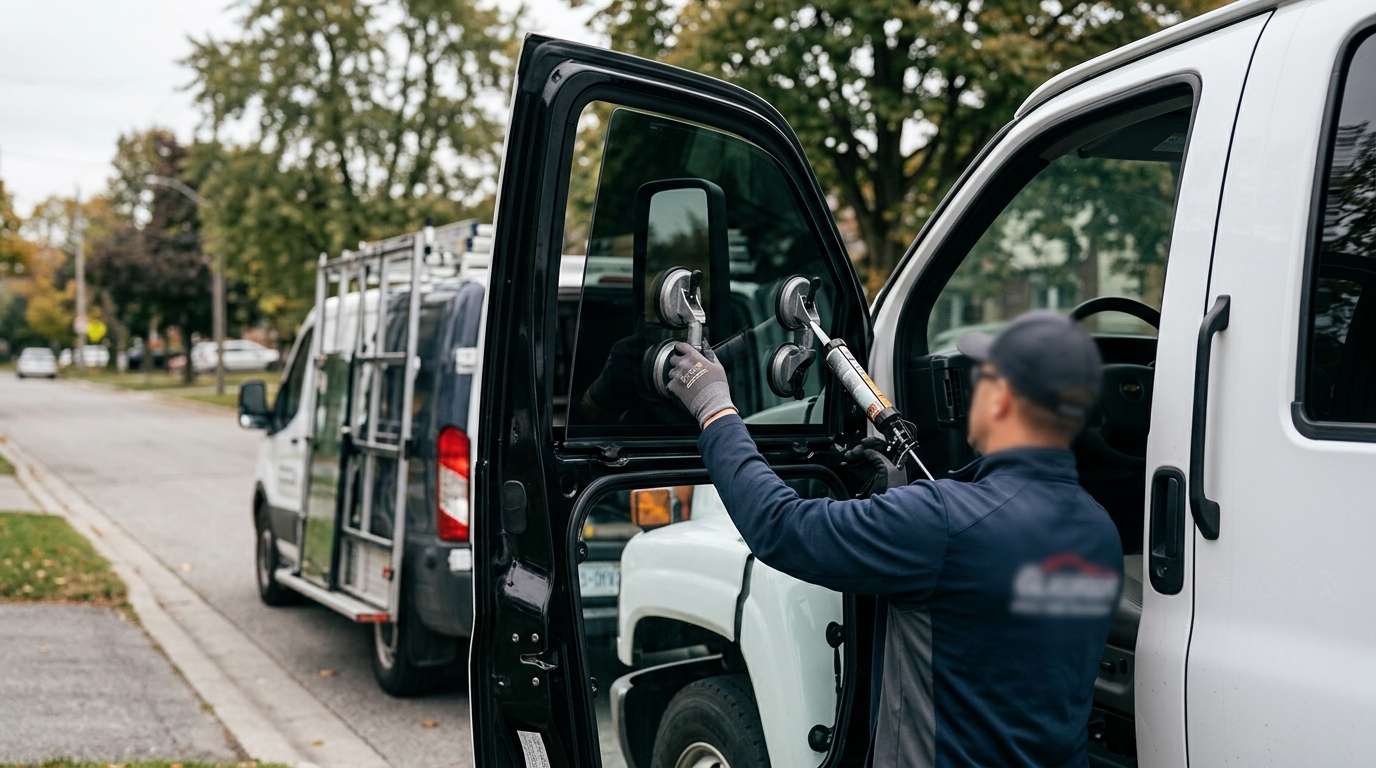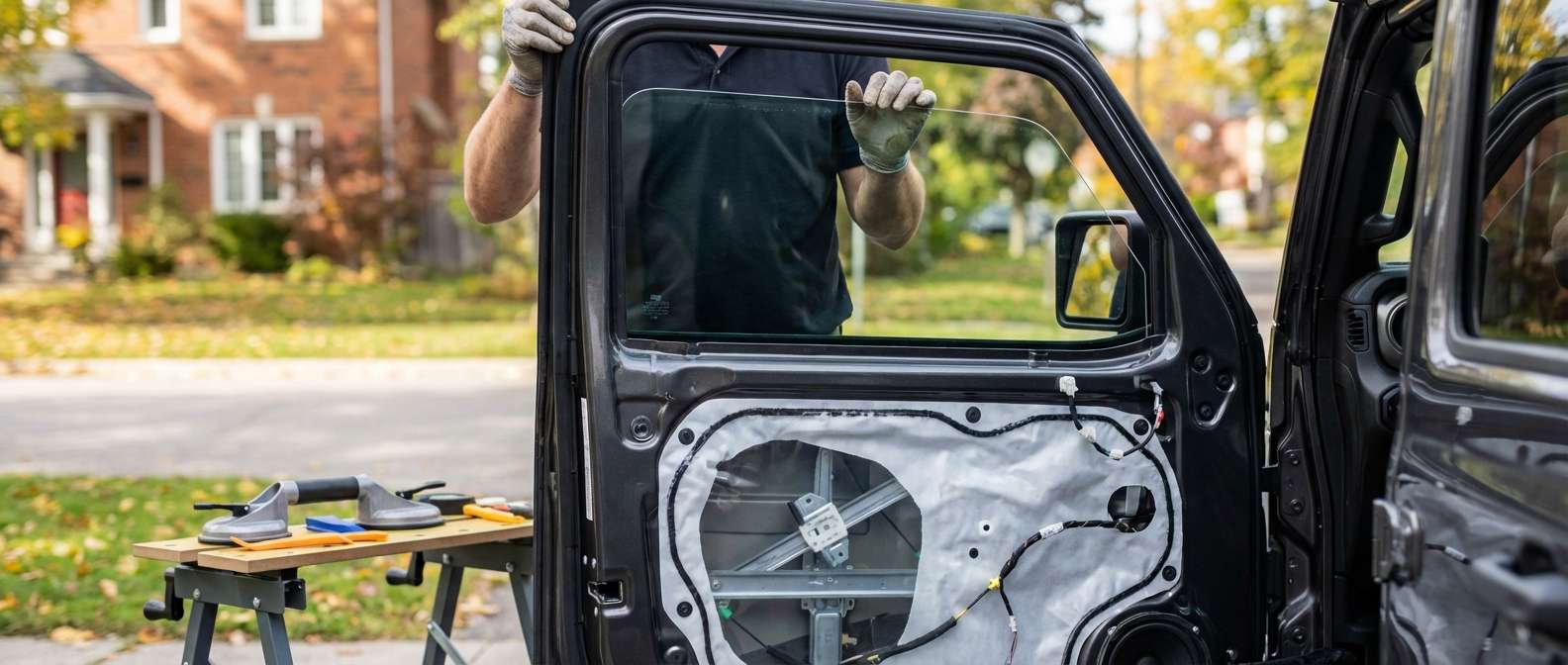
Inspecting Front and Rear JL Door Glass Before Installation
Checking the physical pane before disassembling the full metal doors prevents repeat work, especially given the distinct glass variations across trim levels. For standard full front doors, the factory replacement relies on tempered solar-control glass matching parts 68280918AE for the right front and 68280919AE for the left front, while select trims like the Rubicon 392 utilize thicker acoustic-laminated front glass. I verify the lower mounting tabs immediately: the JL does not use traditional through-glass bolt holes, relying instead on integrated bottom snap-clips designed to lock directly into the composite inner door carrier plate.
For four-door Unlimited models, the rear window setup requires checking the glass edge profile against the vertical division bar that separates the drop glass from the stationary rear quarter ventlite. Rear passenger glass, corresponding to factory parts 68280920AE and 68280921AE, features a deep factory privacy solar tint that must match the adjacent quarter glass rather than the 70–75% VLT solar-green tint found on front driver and passenger doors. Because trail mishaps can leave a cabin completely exposed to the weather, I generally pull up to your location about an hour after you book so the cabin is secured quickly.
Carrier Plate Alignment and Post-Replacement Channel Checks
Unlike earlier generations that utilized an open steel inner door frame with service holes, the JL uses a solid black plastic carrier module that houses the window regulator tracks, wiring harness, and latch linkages as a single unit. Once the replacement glass is seated into the carrier clips, I run specific functional checks to account for known JL operating quirks:
- Track friction and auto-reverse: Fine dust and trail silt build up inside the continuous felt-lined rubber run channels within the upper door frame. If the replacement glass binds against this debris, the anti-pinch safety mechanism triggers immediately and sends the power regulator into reverse. The channels must be cleared and seated so the motor draws normal amperage.
- Regulator clip engagement: Base Sport trims feature manual window cranks, while Sport S, Sahara, and Rubicon trims utilize 12V power regulators. In both setups, incomplete seating into the carrier bracket allows the glass to cock sideways, creating a loud clunk or causing the front edge to jump the run channel when rolling up.
- Partial-drop stability: JL front door glass has a known tendency to rattle when driven over rough terrain with the window opened three to four inches. Verifying tension on the single-guide carrier bracket before reinstalling the interior door trim panel ensures the window stays anchored inside the frame.
- Hinge and wiring harness stress: JL doors are built to be lifted off the vehicle by pulling the Torx hinge pins and unplugging the modular wiring connector. When handling the door, flex on the lower frame can shift the regulator alignment, so cycling the glass after the door is secured to the body is essential.
Why does my new window stop and roll back down automatically?
The JL power window regulator incorporates an anti-pinch sensor that measures motor resistance. If the new glass catches on misaligned rubber weatherstripping or dirt packed into the upper door frame channels, the system detects an obstruction and immediately drops the glass several inches.
Can I swap standard tempered glass for acoustic-laminated glass on my front doors?
The physical drop channels in the full metal door frames accommodate both designs, but acoustic-laminated glass is marginally thicker than standard tempered glass. Installing it requires thoroughly inspecting the interior rubber run channels to ensure the window operates without excessive drag against the regulator motor.
Does the rear door glass on a 4-door include the small corner window?
No. The four-door rear passenger door uses a split configuration. The roll-down glass and the stationary rear quarter ventlite are independent pieces separated by a rigid vertical division bar, meaning a broken roll-down window is replaced without altering the stationary vent glass.