Body Styles and Glass Geometry on the LC Accent
Matching the correct door glass on these cars comes down to the door count, because Hyundai did not use a universal front window across the lineup. The 3-door hatchback uses a noticeably longer front door panel than the 4-door sedan or 5-door hatchback, meaning the glass dimensions are completely incompatible between the two profiles. If you drive a 4-door or 5-door, the front left glass corresponds to factory part 82410-25000 (also crossing to 82411-25000), while the front right corresponds to 82420-25000.
The rear passenger doors on the sedan and 5-door models split the opening into a movable drop glass and a fixed rear quarter glass. These two panes are separated by a vertical division bar. The movable rear drop glass uses part 83410-25000 on the left and 83420-25000 on the right, resting alongside the stationary triangular glass held under part numbers 83561-25000 (LH) and 83571-25000 (RH). Every pane on the vehicle is single-layer tempered safety glass finished with a light green 70% solar tint, with no acoustic membranes, embedded defroster lines, or antenna grids.
| Glass Position (4-Door / 5-Door) | Factory Reference | Glass Construction |
|---|---|---|
| Front Driver Side (LH) | 82410-25000 | Tempered Solar Green |
| Front Passenger Side (RH) | 82420-25000 | Tempered Solar Green |
| Rear Driver Side Drop (LH) | 83410-25000 | Tempered Solar Green |
| Rear Passenger Side Drop (RH) | 83420-25000 | Tempered Solar Green |
| Rear Fixed Quarter Vent (LH) | 83561-25000 | Stationary Tempered |
| Rear Fixed Quarter Vent (RH) | 83571-25000 | Stationary Tempered |
Regulator Grips and Frame Channels
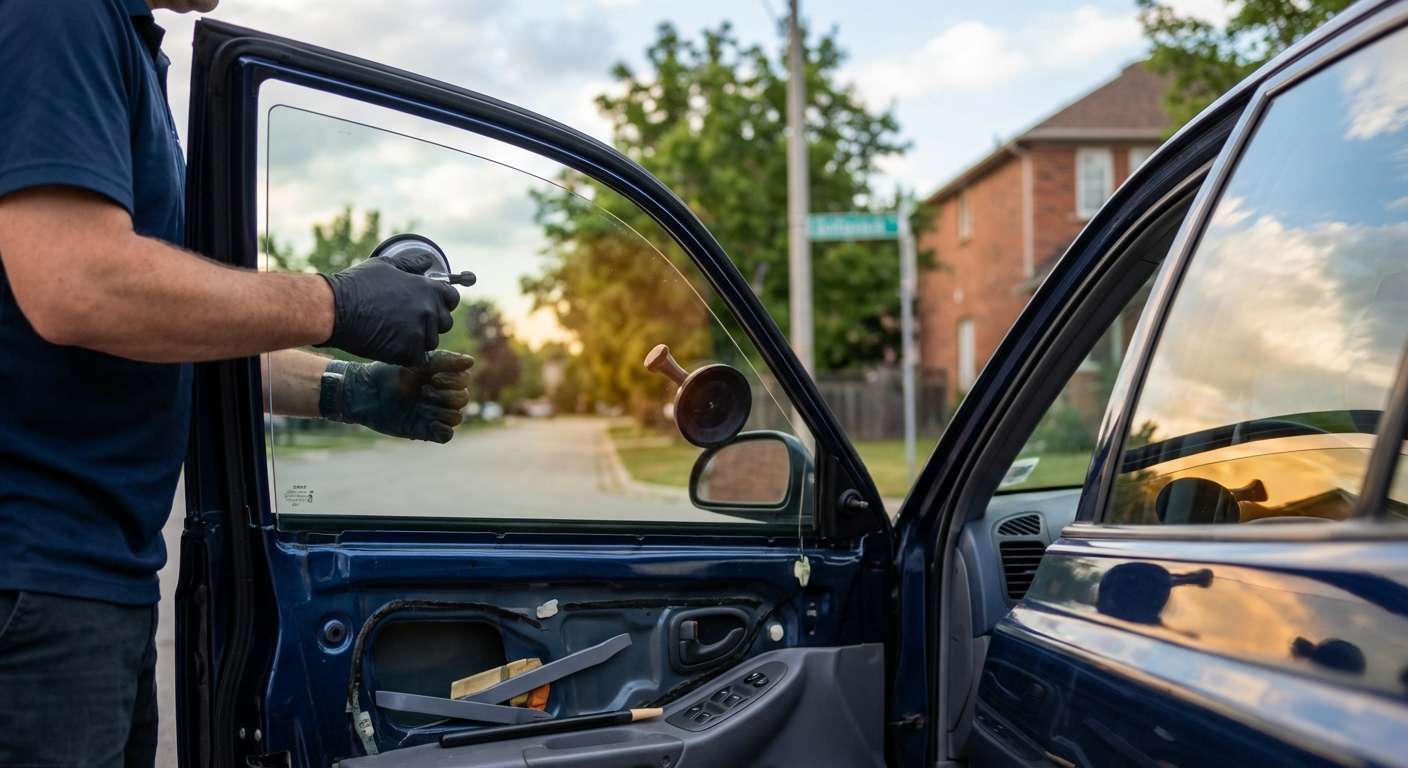
Unlike modern vehicles that use snap-in plastic tabs glued directly onto the glass edge, this setup secures the pane mechanically. The bottom edge of the glass features pre-drilled locating holes that sit inside bolted clamp brackets (assembly 82412-23000), held rigid by M6 retaining bolts. When securing these aftermarket replacement panels into the lift brackets, I back my installation craftsmanship for life, while the glass panel itself is covered for one year.
The pane travels upward into a fully framed welded steel sash lined with rubber run-channel mouldings (part 82530-25000 for the left and 82540-25001 for the right). Behind the interior trim card, the inner door shell is sealed with a plastic moisture barrier anchored by butyl bead. On power-window trims, broken regulator cables or cracked plastic pulleys often cause the glass to drop straight into the bottom of the shell. On manual trims, the regulator connects to a standard hand crank retained by an internal wire clip (part 82630-22001).
Misalignment and Channel Tracking Issues
A frequent mechanical fault on these doors involves the glass tipping forward during upward travel, forcing the leading edge out of the front vertical channel run. This happens when the perimeter weatherstripping dries out, hardens, or gathers road grit, creating friction that overpowers the regulator's upward push. When the glass binds against the channel, the scissor or cable mechanism twists the bottom M6 clamp mountings out of parallel alignment.
- Hardened rubber inside the forward guide sash causing the panel to bind and tilt toward the mirror base.
- Snapping of internal plastic pulley wheels within the door cavity, dropping the tempered glass into the bottom frame.
- Loose M6 retaining bolts at the 82412-23000 bottom clamp bracket allowing the glass to shift off-axis during hand-crank or motor cycling.
- Driver-side master switch contacts burning out, causing erratic lifting force that stresses the physical regulator tracks.