The Reality of Roof Panels on the Enzo
Inquiries about replacing a shattered or leaking sunroof panel on an Enzo invariably stem from a misunderstanding of how Maranello engineered the car. Ferrari manufactured this vehicle strictly as an enclosed berlinetta without any provision for an opening moonroof, fixed panoramic glass, or removable targa assembly. If you check National Auto Glass Specifications, there is no NAGS part number assigned to an Enzo sunroof pane, nor does Ferrari list an OEM part number or exploded diagram for a glass aperture in the roof. The top structure is a continuous, load-bearing carbon-fiber composite skin cured directly over a central structural spine that ties the front bulkhead to the rear engine bay cradle.
What many mistake for a perimeter sunroof frame from the outside is actually the mechanical shut-line of the forward-tilting dihedral butterfly doors. The upper carbon shell of each door swings upward and forward, taking a substantial cut-out section of the outer roof contour with it to allow cockpit entry over the wide side sills. Because the primary upper boundary consists solely of these composite door sections meeting the central carbon spine, the car lacks traditional overhead glass assemblies, motorized tracks, glass-mounted sunshades, embedded defroster grids, or glass-integrated light sensors.
Interior Upper Canopy Structure and Clearances
Inspecting the interior architecture confirms the complete absence of sunroof cassettes, drain tubes, or motor cavities. Factory documentation under Catalog Section 72, specifically Table 115 titled Roof Panel Upholstery and Accessories, documents only a dedicated carbon-fiber and leather-trimmed headliner, driver and passenger sun visors, interior courtesy light fixtures, and the structural mounting base for the central rear-view mirror. When an Enzo shows damage along its upper horizontal surfaces, the issue is consistently structural composite fracture or clearcoat degradation on the carbon monocoque rather than broken automotive safety glazing.
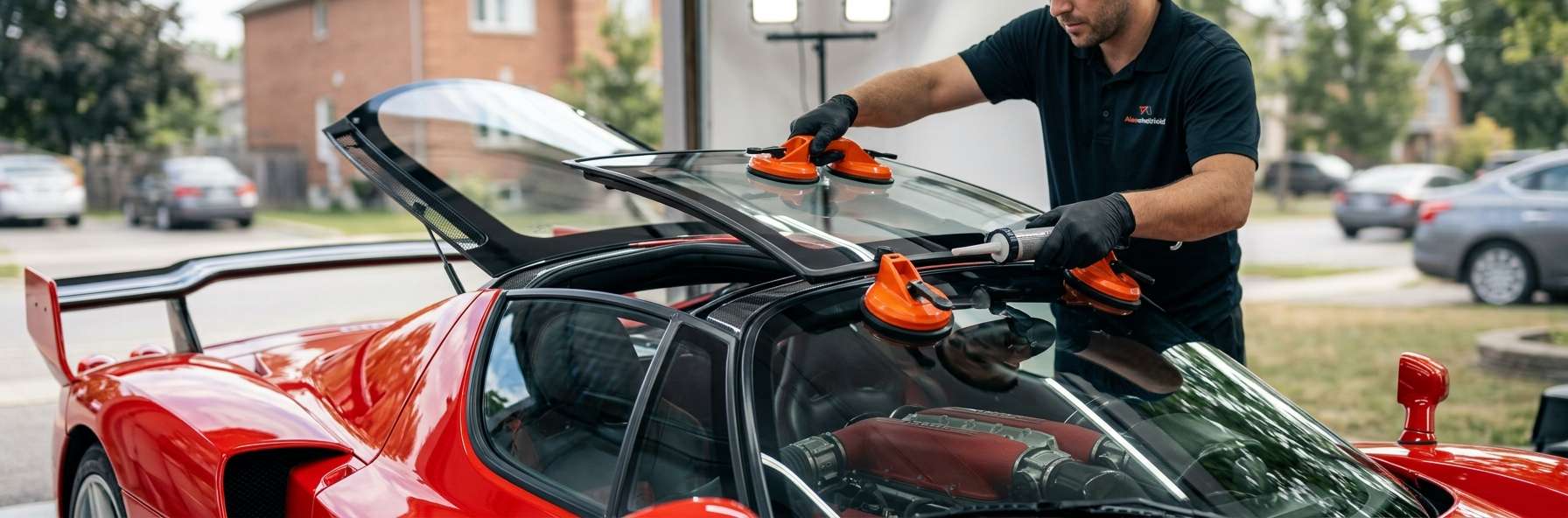
Whenever I travel directly to a client's private garage or workplace anywhere across Toronto and the GTA to assess composite edge seals and adjoining window fitment, verifying these overhead clearances requires close attention to the butterfly door alignment. If an Enzo has undergone an unverified aftermarket coachbuilt alteration featuring a transparent insert, I check the structural integrity of the surrounding composite weave before doing any custom glazing work. Any custom replacement transparent panel must be checked for true optical flatness, edge-chamfer consistency, and zero interference with the upward arc of the door headers when the dihedral hinges cycle open.
Post-Installation Checks for Upper Seals and Door Header Glass
On vehicles modified with custom transparent overhead inserts, post-fitment evaluation focuses entirely on the interface between the central roof spine and the upper door margins. The perimeter of any transparent insert must sit completely flush with the surrounding carbon-fiber weave to prevent turbulent wind buffeting at high track speeds. Any step-down or protrusion exceeding half a millimeter will disrupt the airflow directing high-velocity air toward the rear engine induction tract and the downforce-generating rear aero surfaces.
The interior visual check requires inspecting the seam where the headliner from Catalog Section 72 abuts the frame of the aperture. The sun visor pivot mounts and the interior rear-view mirror bracket must remain completely isolated from any mechanical stress introduced by overhead glazing brackets. Finally, the perimeter weatherstripping running along the upper butterfly door channels must compress uniformly against the fixed central spine without binding or catching along the edges of the transparent panel during closure.