Single-Pane Design and Panel Hardware Across the WD Lineup
Every Durango from the 2011 SXT up through the Hellcat and Citadel trims uses an identical single-pane tilt-and-slide setup over the front row. Unlike its mechanical cousin, the Jeep Grand Cherokee WK2, Dodge never configured this vehicle with a dual-pane panoramic opening, which keeps the replacement panel straightforward. The factory glass assembly is listed under Mopar part number 68091790AB, superseding the original 68091790AA release.
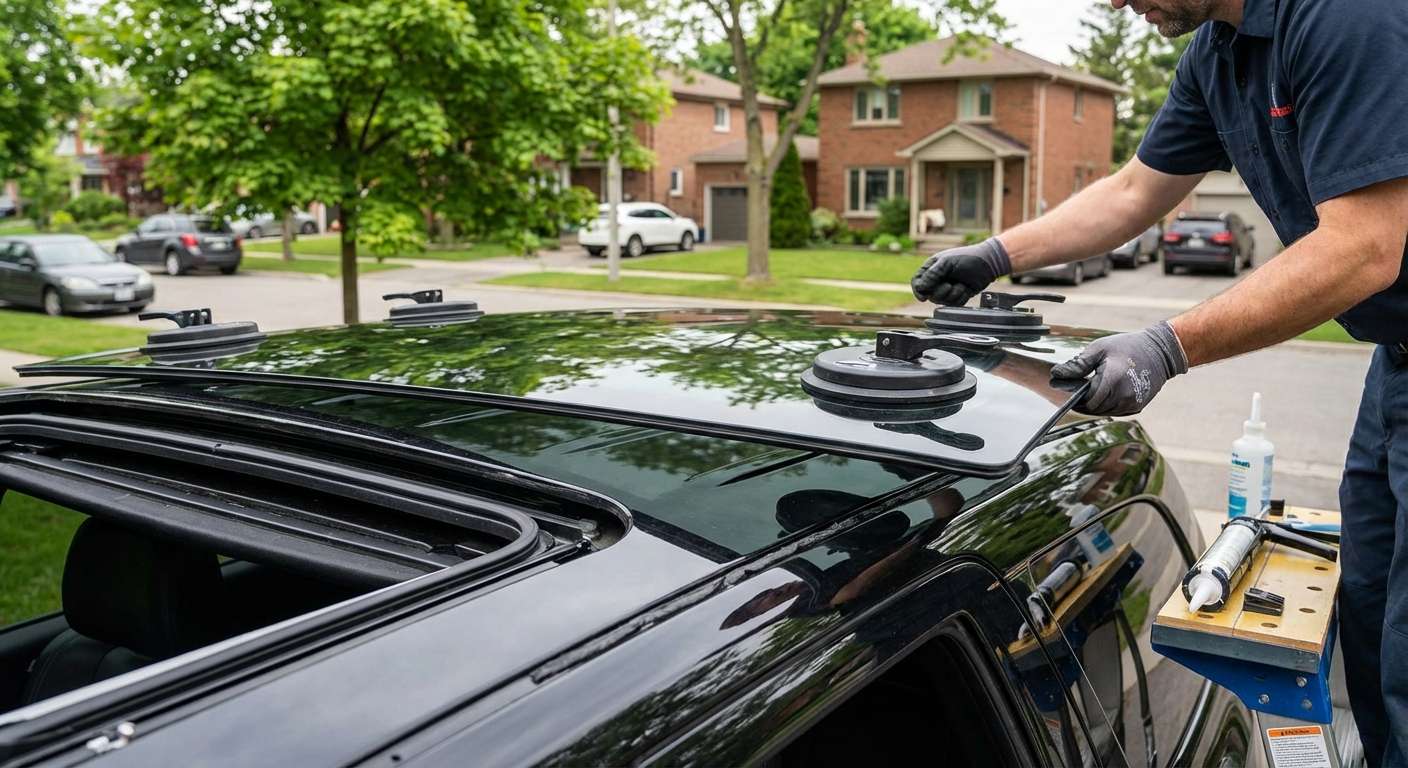
The panel itself consists of tempered dark privacy glass with a solar-control treatment baked in. Because safety systems, rain sensors, and forward-collision cameras mount directly to the front windshield behind the rearview mirror, this glass carries zero wiring, embedded antennas, or defroster lines. Structural support comes from steel mounting brackets bonded directly to the underside of the glass edge. These bonded side brackets seat into the cassette lift arms driven by motor 68082477AB, while an outer perimeter encapsulating rubber seal (part 68082479AA) surrounds the glass edge to prevent cabin buffeting.
Water Management, Wind Deflectors, and Common Roof Leaks
When cabin leaks appear in this roof, they are rarely caused by a physical failure of the glass pane itself. Water manages to seep past the rubber surround by design and drops into an internal catch basin built into the structural frame beneath the roof skin. Four plastic corner spouts direct this liquid into rubber tubes: two drop down the A-pillars toward the floorboards, and two route through the rear pillar cavities.
When those pathways clog with pine needles or dirt, water backs up quickly. The overflow dumps straight into the headliner, soaking the front overhead console, leaking through the sunglasses drop-down pocket, or running behind the lower kick panels right beside delicate interior fuse junction blocks. If you hear high-pitched air whistles on the highway, the perimeter seal has likely shrunk or the glass panel has settled unevenly relative to the roofline. Every replacement panel I fit comes strictly from aftermarket manufacturers like Pilkington, FYG, PGW, or XYG, matched to factory curvature so the perimeter weatherstrip compresses evenly against the sheet metal.
Operating the roof vent or slide also actuates a spring-loaded pop-up wind deflector (part 68346651AA) along the leading edge. If that deflector arm sticks or if the manual sliding sunshade (trim base code 1TA47DX9AA) drags along its internal runners, it puts unnecessary drag on the drive cables, occasionally preventing the glass from sitting flush when closed.
Durango Sunroof Post-Installation Inspection
- Inspect the outer perimeter rubber seal (68082479AA) to ensure it sits uniform and flush with the roof skin without pinched corners or wavy gaps.
- Look at the glass height from the outside; the leading edge should rest roughly one millimeter below the roofline, while the trailing edge should sit flush or slightly above to prevent wind noise.
- Cycle the power switch through full vent, open, and close to verify the front pop-up wind deflector raises and collapses smoothly without binding against the glass frame.
- Slide the interior cloth sunshade forward and backward by hand to confirm the glass brackets do not catch on the fabric liner.
- Examine the overhead console and sun visor areas after washing to ensure water drains through the internal channels rather than pooling inside the cabin trim.